How Many Worksheets 1 - 10: Essential Tools for Early Learning
The Role of Foundational Math Resources in Early Education
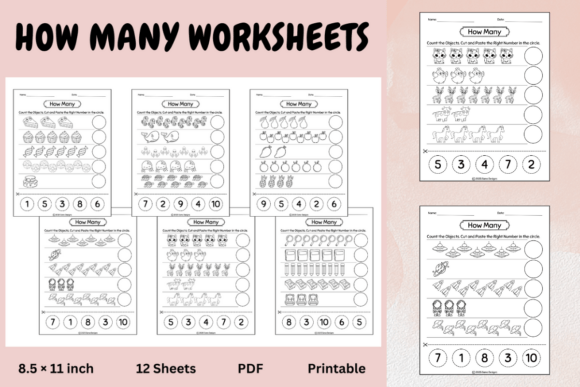
In the landscape of early childhood education, finding resources that balance engagement with genuine skill development is critical. The "How Many Worksheets" set, covering numbers 1 through 10, serves as a practical cornerstone for this developmental stage. This 12-page digital product is engineered specifically for preschoolers, kindergarteners, and early elementary students who are navigating the complex transition from passive observation to active numerical recognition. Unlike generic activity sheets, this collection focuses on the specific cognitive leap required to associate a quantity with a written symbol, a fundamental aspect of numeracy.
For the educator, parent, or homeschooler, the value lies in the structured repetition and the integration of multiple learning modalities. The set includes six cut-and-paste worksheets alongside six count-and-write worksheets. This dual approach ensures that children are not merely memorizing shapes but are engaging in tactile and kinesthetic learning. By physically manipulating paper pieces to represent numbers, children strengthen the neural pathways associated with quantity and value. This resource acts not just as a time-filler, but as a deliberate tool to build the scaffolding necessary for more complex mathematical concepts later on.
Visual Characteristics and Design Utility
From a design perspective, the "How Many Worksheets" set prioritizes clarity and hierarchy. The layout is intentionally clean, utilizing ample white space to prevent cognitive overload for young learners. The typography used for the numbers is bold and distinct, ensuring high legibility even for children with developing visual acuity. This is a crucial design consideration; in educational materials, the aesthetic must always serve the function. The visual personality of these worksheets is approachable and friendly, avoiding the clutter that often characterizes low-quality printable resources.
While this is a worksheet set rather than a traditional typeface, the design principles applied mirror those found in premium font creation. The characters (numbers) are crafted to be recognizable and consistent, serving as a visual anchor for the child. For designers and content creators working in the educational sector, observing the layout of "How Many Worksheets" offers insights into effective information architecture for young audiences. The balance between visual elements and negative space demonstrates how to guide the eye naturally—a skill transferable to logo design, web design, and editorial design. The set proves that effective design assets do not need to be complex; they need to be intentional.
Practical Applications and Skill Building
The versatility of "How Many Worksheets" extends across various educational environments. In a traditional classroom setting, these pages serve as excellent independent work stations or "morning work" to settle students into a learning mindset. For homeschoolers, the set provides a structured curriculum supplement that requires minimal preparation—simply print and go. The inclusion of both JPG and PNG files ensures compatibility with various digital learning management systems, allowing educators to upload them directly to tablets for a paperless experience if preferred.
The specific focus on fine motor skills cannot be overstated. The cut-and-paste components require precision, bilateral coordination, and control. These are the same physical skills required for handwriting, tying shoes, and other daily tasks. By integrating these motor skill exercises with math practice, the worksheets offer a holistic developmental approach. The "count-and-write" sections reinforce this by encouraging the practice of number formation. This repetitive motion builds muscle memory, transitioning the child from tracing numbers to writing them independently. For the brand strategist or publisher, this highlights the importance of creating products that solve multiple problems simultaneously, thereby increasing the perceived value and utility of the asset.
Integrating Educational Assets into Your Workflow
For small business owners, bloggers, and content creators in the parenting niche, resources like "How Many Worksheets" are invaluable content pillars. They provide tangible value to an audience seeking solutions for their children's education. When discussing early childhood development or homeschooling curricula, recommending specific, high-quality tools establishes authority and trust. This aligns with E-E-A-T (Experience, Expertise, Authoritativeness, and Trustworthiness) principles, as it demonstrates a curated selection process rather than generic advice.
Furthermore, the ease of access to these design assets—delivered as print-ready PDFs and high-resolution images—streamlines the workflow for busy professionals. There is no need to wrestle with complex formatting; the visual hierarchy is already established. This efficiency allows creators to focus on the broader narrative of their content, whether it is a blog post about "Summer Learning Loss Prevention" or a social media campaign promoting "Hands-On Learning." The set stands as a testament to the power of simple, well-executed design in facilitating complex educational goals. It serves as a reminder that the most effective tools are often those that remove friction between the user and the task at hand.